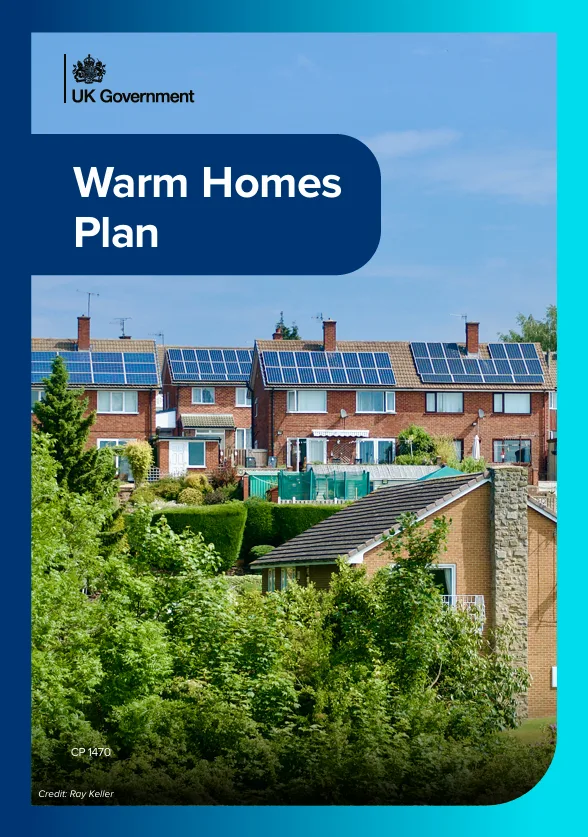
The Warm Homes Plan sets out a long-term framework to help households reduce energy bills permanently by improving the energy efficiency of homes through upgrades. It looks beyond temporary relief, aiming to tackle fuel poverty and inefficient housing head-on by making energy-saving and low-carbon upgrades more affordable and accessible.
Key goals include:
Lowering household energy bills long-term.
Improving home comfort and warmth.
Supporting up to 5 million homes with efficiency upgrades by 2030.
Lifting up to 1 million families out of fuel poverty.
Download The Warm Homes Plan Cheat Sheet
The Warm Homes Plan: Three Primary Pillars
1) Low-income Homes Funding
Low-income deemed homes are expected to receive support to cover the cost of home energy upgrade packages, based on successful applications.
2) Zero/Low-interest Loans
Households will also be able to apply for new government-backed, low or zero-interest loans for the installation of energy efficiency upgrades under the Warm Homes Plan.
3) Renters' Protection
Updates to renter's protection means support for landlords will improve over the course of the plan. For the majority, especially those renting a home, private or social, landlords will have the responsibility to ensure a healthy, warm and energy-efficient home which is also affordable.
💷 Funding Options for Homeowners
For most homeowners, the new Warm Homes Fund will provide low-interest and zero-interest loans to help cover the cost of installing energy-saving measures like:
Government-Backed Loans
Solar Panels
Battery Storage Syste,s
Heat Pumps
Insulation (loft, wall, floor)
Fully Funded Grants Through the Warm Homes: Local Grants
In England, the Warm Homes: Local Grant supports energy efficiency upgrades at no upfront cost for eligible homeowners on lower incomes or in homes with poor energy performance.
Grants can cover improvements that raise the Energy Performance Certificate (EPC) rating to at least Band C. Local councils typically manage applications and delivery, partnering with contractors to complete the work. Funding is targeted where it will have the greatest impact on energy bills and living conditions.
Tip: Even if you don’t qualify for the fully funded grant, you may still benefit from loans or other subsidy schemes.
Read Our Warm Homes Plan Overview
"The Warm Homes Plan marks a significant turning point in how energy efficiency. Clean technology and household affordability are addressed across the UK..."
What Home Upgrades Are Included In The Warm Homes Plan
Here are the most common Warm Homes Plan energy efficiency upgrades that homeowners can access:
☀️ Renewable & Low-Carbon Technologies
Solar panels and batteries – Reduce reliance on grid electricity and cut energy costs.
Air source or ground source heat pumps – Cleaner heating systems that replace or supplement traditional boilers.
Smart heat controls – Improve heating efficiency and optimise energy usage.
🧱 Fabric-First Home Improvements
Loft, wall, floor insulation
Draught-proofing
Window and door upgrades
📌 Warm Homes Plan Energy Efficiency Upgrades Eligibility, and How to Apply
Eligibility depends on several factors, including:
Your home’s current EPC rating – Lower ratings often indicate higher priority for funding.
Household income and benefits status – Especially for fully funded grants.
Local authority participation – Not all regions are rolling out the Warm Homes Local Grant at the same time.
Property ownership status – Homeowners generally have direct access; private renters may need landlord consent.
However, details are still being finalised and rolled out. Whilst the warm homes plan eligible energy efficiency upgrades above coupled with low or zero-interest loans, it doesn't escape the fact that installation is still a relatively large investment. Households will still need the supporting systems required to install the Warm Homes Plan Energy Efficiency Upgrades identified above.
Have questions about eligibility or how to start your retrofit journey? Contact us for personalised guidance and next steps...
Under the Warm Homes Plan 2026, eligibility is broad but tiered.
Low-income households and those in fuel poverty are prioritised for fully funded upgrades, including solar panels, heat pumps and battery storage, delivered through local authorities and social housing programmes.
Homeowners and private renters in properties with poor energy efficiency ratings may also qualify for grants where income thresholds or benefit criteria are met. In addition, the plan introduces government-backed low- and zero-interest loans available to households regardless of income, enabling wider access to clean heating and renewable technologies.
Eligibility and support levels vary by scheme and region, but the most generous assistance is targeted at vulnerable households.
Book a meeting with us to get your FREE Housing 2025 guest pass. Or simply pop by our stand, we will be handing out Welsh Cakes!
Award-winning Social Enterprise delivering seamless, high standard compliance, and managed services taking the strain from social landlords and installers.
We use cookies to enhance your browsing experience, serve personalised ads or content, and analyse our traffic. By clicking "Accept", you consent to our use of cookies.
Functional
Always active
The technical storage or access is strictly necessary for the legitimate purpose of enabling the use of a specific service explicitly requested by the subscriber or user, or for the sole purpose of carrying out the transmission of a communication over an electronic communications network.
Preferences
The technical storage or access is necessary for the legitimate purpose of storing preferences that are not requested by the subscriber or user.
Statistics
The technical storage or access that is used exclusively for statistical purposes.The technical storage or access that is used exclusively for anonymous statistical purposes. Without a subpoena, voluntary compliance on the part of your Internet Service Provider, or additional records from a third party, information stored or retrieved for this purpose alone cannot usually be used to identify you.
Marketing
The technical storage or access is required to create user profiles to send advertising, or to track the user on a website or across several websites for similar marketing purposes.