The New Social Value Model PPN 026: What It Means for Retrofit
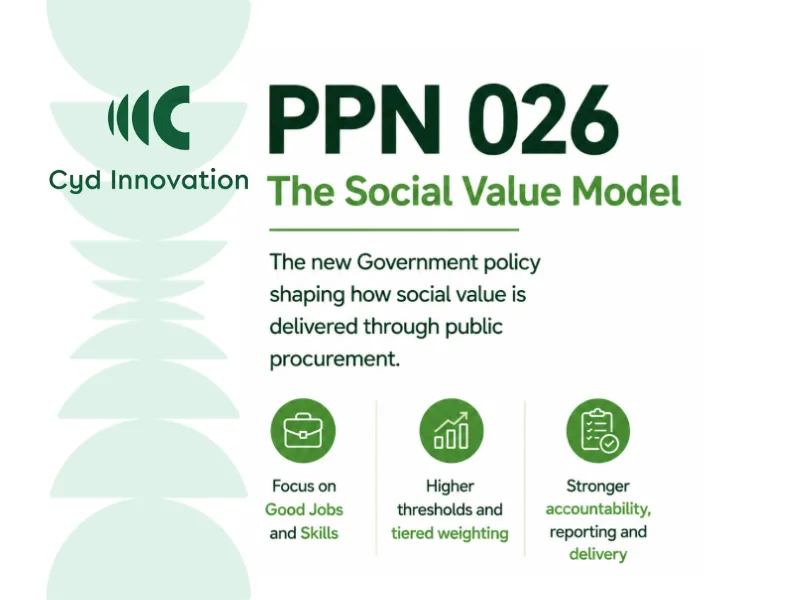
On the 5th of August 2026, the Government published Procurement Policy Note 026. The Social Value Model (PPN 026), the latest iteration of its approach to embedding social value within public procurement. Coming into force from 1 January 2027, the new model will replace PPN 002, which itself only became mandatory in October 2025, and will apply to all eligible central government procurements valued at £1 million or more.
Introduced as part of the Government's commitment to deliver "growth in every postcode", it marks a major change in how we define, prioritise, deliver, and report on social value.
New Social Value Model PPN 026: The Major Changes to the Social Value Model
Simplification of Outcomes
PPN 026 significantly narrows the scope of what counts as social value. The 5 missions and 8 policy outcomes seen in PPN 002 that covered economic growth, clean energy, safer streets, breaking down barriers and the NHS, have been stripped back to just 2:
- Good Jobs – This covers creating and retaining high quality jobs, fair working conditions, and fair pay.
- Skills – This covers training and retraining, in-work progression and talent pipelines.
Increasing the Thresholds
PPN 026 will only apply to central government contracts of £1 million or more (inc. VAT), an increase from the £139,000 threshold seen in PPN 002. Any contracts below the £1 million threshold will no longer be required to include the model in their procurement process.
Tiered Weighting
PPN 026 introduces tiered weighting. Like PPN 002, in-scope contracts will have a 10% score weighting dedicated to social value. However, once the contract value reaches £5 million or more, that mandatory weighting doubles to 20%, giving social value true influence to determine who wins these larger contracts.
Accountability and Consequences Under PPN 026
PPN 026 sees the Social Value Model move from unmonitored, unreported tender-stage promises to proven delivery and annual reporting. Contracts at the £5 million threshold must include at least one social value KPI that is reported on at least every 12 months, with failure to deliver having genuine consequences on future procurement success. This move to managing, monitoring and evidencing is a clear step toward accountability on contract.
Examples of Good Practice
PPN 026 encourages bid writers to provide a ‘List of Community Programmes’. This development seems to encourage bidders to go beyond open-ended, vague proposals where TOMs is simply used as a checklist and truly engage with local delivery partners.
What Does PPN 026 Mean for the Retrofit Sector?
For the retrofit sector, PPN 026's focus on jobs and skills aligns closely with one of the industry's most pressing challenges: building and sustaining a workforce capable of delivering the UK's net zero ambitions.
On one hand, the sector continues to face significant skills shortages, with concerns around an ageing workforce and an insufficient pipeline of new entrants. The new model's focus on employment, training and progression could strengthen the case for apprenticeships, local recruitment initiatives, trainee pathways and the upskilling of existing workers. Under this narrower model, contractors who have already prioritised job and skills development will be well placed to score highly when bidding for works.
At the same time, retrofit remains heavily influenced by Government funding cycles. The sector has experienced repeated periods of policy and funding uncertainty, making long-term workforce planning difficult. If funding programmes continue to operate on short-term timescales, suppliers may find it challenging to sustain the ambitious employment outcomes promised under PPN 026 after the contract has passed.
There are also concerns that SMEs may be disadvantaged when bidding if they are compared to larger organisations with dedicated recruitment teams and larger scale skills and placement programmes. If social value contributions are reduced to solely number of jobs created, we risk discounting the valuable local impacts and community insight SMEs bring to contracts.
PPN 026 and the New Social Value Model: In Summary
PPN 026 is a strategic shift to a more focused, accountable and measurable model that links procurement activity directly to employment outcomes. However, it is also fair to question whether, by reducing the breadth of PPN 002, we risk creating unintended consequences for the environment, SMEs, and VCSEs that have used social value policy as a lever to deliver meaningful impact beyond jobs and skills.
From January 2027, any organisation bidding for central government contracts will need to focus on demonstrating how they create good jobs, develop skills, and deliver tangible outcomes that they can confidently deliver on and report.
With the technical guidance expected in autumn 2026, the next few months will be vital in understanding how this new model will work, and if it will deliver on its promises to support British businesses, boost growth and build a fairer economy.