
The Construction skills shortage: Why the UK Can’t Find Young Retrofit Workers. And What It Means for Net Zero
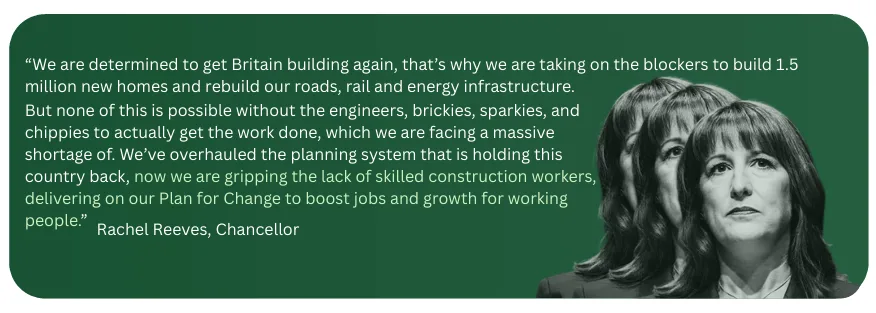
Construction plays a significant role in the UK’s economic growth. Evidence from the CIOB’s The Real Face of Construction 2020 report shows that the sector contributes 6%of the UK’s GDP. And provides employment for 7.1% of the workforce. Recognising the importance of construction for both economic development and environmental goals, particularly the shift towards net-zero carbon emissions, the government has invested £600 million to train 600,000 skilled construction workers to address the growing construction skills shortage.
Despite this demand, according to research by the CIOB, two-thirds (68%) of young people hold a positive view of construction careers. Yet only one third (31%) would consider joining the sector. With substantial resources being made available and young people being the target workforce, the pressing question remains. "why aren’t more young people pursuing careers in construction?"
This paradox is particularly concerning in the domestic retrofit sector, which is central to the UK’s net-zero ambitions. Without a new generation of workers, meeting housing and energy efficiency targets could stall. The challenge is compounded by demographics: around one third of the construction workforce is expected to retire by 2035 4. Additionally, the older generation is reluctant to upskill, as they expect to retire soon, which is understandable, given that some are anticipating retirement in 3 years, and certain training can take up to almost 3 years to complete. Thus, they are not able to meet the specific energy efficiency needs of the retrofit sector.
Currently, the UK is operating with a significant workforce deficit, edgings towards a construction skills shortage. Or even crisis. According to Sadiq Khan (Mayor of London), approximately 230,000 additional
professionals are needed to achieve the UK’s net-zero goals. These figures make one thing clear: without rapid, large-scale investment in training and workforce development, the UK will struggle to meet its retrofit and decarbonisation targets. Alongside funding limitations, the shortage of skilled professionals represents one of the biggest barriers to achieving net zero by 2050.
Why the skills shortage exists – the challenges associated with attracting and retaining youth within the construction industry
Negative opinions toward the construction & retrofit industry
Despite growing recognition of the benefits offered by the retrofit industry, many young people continue to hold negative perceptions of careers in construction. Common
beliefs include that roles are physically demanding, unattractive, or potentially low paying. These views often form before students are introduced to the specific opportunities within retrofit, as the broader construction industry already struggles with an image problem. Research by the Chartered Institute of Building (CIOB) highlights the extent of the challenge. 47% of young people said construction careers were not covered in the careers advice they received in education.
School, after the home, is one of the most influential environments for a child. Shaping many of their opinions and aspirations. Because students often form close relationships with teachers, they frequently seek career advice from them. While a teacher’s familiarity with a student can lead to insightful guidance, challenges arise specifically when it comes to career advice about construction and retrofitting. Two significant issues illustrate these challenges.
1) Many teachers are unaware of the variety of career opportunities in the
construction sector. Their understanding is often limited to traditional roles,
such as electricians, plumbers, and bricklayers. As a result, teachers are unable
to fully advise students about all the options available. Consequently, students
believe there are few prospects in the sector or are uninterested in the limited
options presented.
2) Some teachers display unconscious bias toward students perceived as more or
less academically capable. As a result, teachers may encourage academically
stronger students to pursue A levels, while guiding others toward vocational or
technical pathways, thus reinforcing limited career perspectives for both groups.
This outdated mindset overlooks the demand for academically strong individuals
in the construction and retrofit sector, especially in non-traditional roles.
.
- 31% agreed the sector lacks good career opportunities.
The construction sector does not lack “good” career opportunities. There is just a lack of awareness of those career opportunities.
Opportunities in Construction & Retrofit Industry
While perceptions of construction remain mixed, the retrofit sector presents a range of exciting, high-tech, and socially impactful career opportunities. Many of which are being created through the government’s Retrofit Growth Strategy. Key components of this strategy include developing a skilled workforce through targeted training and apprenticeships, such as those ordered by the Warm Homes Skills Programme (WHSP). This UK government initiative provides subsidised training for professionals involved in home energy efficiency, including the installation of insulation and solar panels.
Additionally, the £600 million investment to train 60,000 skilled construction workers further demonstrate the scale of opportunity in the sector. However, it appears that many young people may not yet be fully aware of these pathways. These career opportunities generally came about due to the rising need for green skills jobs as well as the need for retrofit activities in efforts to achieve the UK’s net zero carbon emissions goals.
1) Green skills and jobs
Green jobs are those that contribute to preserving or restoring the environment and our planet, while green skills are the knowledge, abilities, values, and attitudes needed to live in, develop, and support a society that reduces the impact of human activity on the environment.
Green skills are also needed for jobs that are considered non-green. They help make all types of work more environmentally sustainable and are increasingly required by employers to meet net-zero targets and manage rising energy costs. The demand for these skills spans the entire economy. Not just explicitly "green" sectors like renewable energy, to adapt to a changing job market and regulatory environment.

This sentiment perfectly aligns with the rise of green jobs. Roles within the retrofit sector directly contribute to restoring the environment and making buildings more sustainable,
offering young people a career that is not only rewarding but also truly meaningful. For Gen Z, pursuing a career in retrofit isn’t just a job. It’s a way to make a tangible impact on the planet.
2) Retrofit Boom
The retrofit sector is a breeding ground for career opportunities. Ashden estimates that 50,000 qualified Retrofit Coordinators will be required by 2030. A data scrape conducted on the TrustMark website revealed that there are currently 1042 accredited retrofit coordinators in the UK.
Here are a few nontraditional construction careers that could be considered within the construction sector:
- Acoustics consultant
- Building information modelling (BIM) specialists
- Project managers
- Environmental consultant
- Equipment rental coordinator
- Surveyors
- Logistics coordinator
- Legal council
- Procurement specialist
Digital tools
One of the key challenges facing the retrofit sector is the lack of reliable building data. Incomplete or inaccurate property information makes it difficult for project teams to plan effectively. Thus often resulting in delays and cost overruns. However, this weakness also represents a major opportunity for roles in software development, data analysis, and AI, areas where Gen Z is increasingly skilled and confident. By leveraging technology, the retrofit sector can not only improve efficiency but also attract young talent eager to apply their digital expertise to meaningful, climate-positive work.
Social Impact
Building on the idea of purposeful careers, the retrofit sector offers significant social impact. It creates jobs, improves community health and wellbeing, enhances the environment, and delivers energy-efficient housing. This reduces costs and carbon emissions for young people seeking careers that make a tangible difference, retrofit provides an
opportunity to contribute to both people and planet, making their work truly meaningful.
Career progression
Careers in retrofit clear pathways for advancement. Entry-level roles such as Retrofit Assessor or Retrofit Advisor provide a starting point, with opportunities to progress to positions like Retrofit Coordinator, Retrofit Designer, or Retrofit Evaluator, as defined by the PAS 2035 standard.
From there, further advancement can lead to project management, policy roles, training, technical sales, or even establishing your own business within the sector. Continuous professional development, supported by industry qualifications and membership in professional bodies, helps facilitate this growth and ensures that individuals can build long-term, rewarding careers in retrofit.
Workplace Culture
-35% believe construction has a poor workplace culture.
Unfortunately, research over the years has shown that construction has a very poor workplace culture. Primarily due to Poor communication, a lack of appreciation for employees, long hours, physical strain, high-stress environments, and overworked individuals. As a result, workers tend to have high levels of anxiety and depression, tragically leading to suicide in some cases.
This troubling reality is highlighted by the fact that construction has one of the highest suicide rates in the UK. According to the Office for National Statistics (ONS), construction workers are three times more likely to. take their own lives compared with the national average, with an average of three construction workers dying by suicide each day.
Fostering A More Positive Work Environment
In response to these concerning statistics, the sector has been trying to shift towards a more positive working environment. This has included introducing more flexible work options and new tech-driven models, encouraging open discussion about mental health, as well as offering support and improving diversity and inclusion.
Reflecting this push for change, a consultation on mental health issues facing the UK construction industry has been started by the Construction Leadership Council (CLC). With a deadline of November 5, 2025, the consultation follows a series of focus groups conducted around England in collaboration with Mates in Mind and the University of Warwick to identify the primary underlying reasons for poor mental health in the construction industry.
“As leaders in the built environment and construction sector, we have a collective responsibility to our workforce to improve the health, safety and wellbeing of our people. By working in partnership and being ambitious, we can drive improvements in mental health across the sector, ensuring a positive working environment for our current and future workforce.” Said Mark Reynolds, CLC Co-Chairman, recognizing the need for a change in the sector.
External Perspectives On Construction As a Career Path - Possible Reasons Behind The Construction Skills Shortage?
- 36% feel it is not a well-respected career path.
Whether construction is viewed as a well-respected career is not a definitive idea. Opinions differ depending on each person’s experiences, understanding of the sector, and personal values. What can be said with certainty, however, is that construction will always be essential. The demand for skilled workers will never disappear. The industry forms the very foundation of our societies, creating the buildings and infrastructure we rely on every day.
Like any other sector, construction has both positives and negatives. Yet it continues to evolve, offering a wider range of roles that go far beyond traditional perceptions of the field. Its vital contribution to society deserves greater appreciation, as without it, many of the comforts and conveniences we enjoy today would not exist.
Gender
- 53% agree construction is not a welcoming sector for women.
While the field remains male-dominated, with women representing only around 15% of the workforce, this imbalance does not necessarily mean the industry is unwelcoming. In fact, construction is actively working to become more inclusive and diverse, with significant progress being made across many organisations.
Jackie Janssen of the Considerate Constructors Scheme highlights five key strategies being adopted to make the sector more welcoming and accessible for women:
- Establishing Women's Networks and Mentorship Programs
- Offering Flexible Working Arrangements
- Providing Inclusive Facilities on Site
- Addressing Unconscious Bias and Gender Equality Training
- Promoting Female Role Models and Inspiring Future Generations
“Construction is a sector where people value the work that they do. It offers a vast range of occupational opportunities to suit everyone. It is open to all, aiming to attract more women and improve its inclusivity and diversity.” Says Catherine Morris-Robert, Senior Skills Delivery Officer at Regional Skills Partnership North Wales.
Women bring unique perspectives and strengths to the construction industry. As Cavendish Professionals note, “Women often approach problems differently, offer new
solutions, and can spotlight areas of concern that might otherwise be overlooked. Their inclusion ensures a well-rounded approach to project management, design, and implementation.” This reinforces the growing recognition that women are essential to the sector’s innovation, efficiency, and progress.
External Perspectives On Unprofessionalism
- 24% consider the sector unprofessional.
The term “unprofessional” is highly subjective and cannot be fairly applied to the entire industry. The construction sector’s reputation is often influenced by public perceptions of site based work, inconsistent communication, or isolated cases of poor conduct. In reality, the sector encompasses a wide range of skilled, regulated, and technically demanding professions that require qualifications, safety compliance, and professional standards.
Employers lack long term workforce vision
Construction companies in North Wales are predominantly micro employers, focusing on short-term contracts rather than long-term workforce development. This reactive
approach limits their ability to plan strategically for future skills needs.
Limited workforce forecasting: Around 95% of construction employees work for small firms that lack 6–12-month workforce forecasts. As a result, most employers concentrate on immediate projects instead of anticipating future labour and skills requirements.
Passive relationship with training bodies: Many employers view the Construction Industry Training Board (CITB) primarily as an advisory body, rather than actively communicating their emerging skills needs. This reduces opportunities to align training provision with industry demand.
Impact on future market readiness: The absence of long-term planning hampers preparation for emerging requirements, such as ESG standards in tenders and other sustainability-driven market shifts.
Pipeline uncertainty: Employers and housing associations often struggle to forecast funding for retrofit projects. This leads to insecurity in job availability and workforce planning. This uncertainty prevents businesses from confidently recruiting and training apprentices, whose qualifications typically require three years before they can work independently.
Mismatch between training timelines and project flow: The time required to train apprentices contrasts with the unpredictable nature of construction project pipelines, creating a mismatch between skills supply and demand.
Need for greater project stability: Employers express a clear desire for more security in project flow to justify investments in apprenticeships and long-term workforce development. Without this, the sector risks facing a skills shortage, as the current workforce will not meet retrofit demand quickly enough.
Employees cannot afford to pay apprentices a salary
Many small and medium-sized enterprises (SMEs) struggle to afford the cost of hiring apprentices. While training is often government-funded, employers are still responsible for paying apprentices’ wages. This can place a significant financial burden on smaller firms with tight profit margins. This challenge is particularly evident in North Wales, where 91.1% of construction enterprises are classified as micro-enterprises, employing fewer than 10 people. For these businesses, taking on an apprentice represents a major financial commitment, especially when productivity may initially be lower as the apprentice develops their skills. Consequently, financial barriers discourage many employers from offering apprenticeship opportunities, limiting both workforce development and local economic growth. The sector requests Welsh Government to reintroduce financial incentives to ease employer costs and encourage apprenticeship recruitment.
Solutions To The Construction Skills Shortage / Shifting the Landscape
Training & Education
Build partnerships between schools, colleges, and trade institutions to ensure retrofit-specific training becomes widely available.
Launch government-funded grants or incentives to support schools and colleges that want to offer retrofit programs.
Offer modular, flexible training pathways for adult learners and career changers.
Career Path Development
Organize career panels and outreach events featuring successful retrofit to challenge misconceptions and share real-world success stories.
Train career advisors and tutors to understand retrofit roles so they can confidently recommend them.
Emphasize the environmental and economic benefits of careers in retrofit particularly for younger generations motivated by purpose and climate action.
Construction Industry Paradox: Turning Admiration into action.
The construction paradox is clear: young people admire the industry, yet too few are choosing careers in retrofit. With the UK facing a construction skills shortage, an ageing workforce, and ambitious net-zero targets, the need for new talent has never been greater. Retrofit offers meaningful work, career progression, digital innovation, and social impact. Making it a sector perfectly aligned with the values of Gen Z. By raising awareness, improving perceptions, and investing in training, the industry can transform admiration into action, ensuring a skilled workforce ready to tackle the climate challenges of today and tomorrow.