MEES stands for Minimum Energy Efficiency Standards. The regulations establish minimum energy performance requirements for certain privately rented properties in England and Wales.

For landlords in England and Wales, the minimum EPC rating is changing. Today, most privately rented domestic properties must meet a minimum EPC E rating, unless a valid exemption applies. However, the Government intends to raise the minimum energy efficiency standard to EPC C or equivalent by 1 October 2030.
That is a significant change, and it raises an important question: is your property portfolio ready for what is coming? The answer cannot simply come from looking at today's EPC ratings. The Government is also reforming Energy Performance Certificates (EPCs), with new metrics expected to assess fabric performance, heating systems, smart readiness and energy costs. Reformed domestic EPCs are currently planned for the second half of 2027.
This means landlords have two things to prepare for: a higher minimum energy efficiency standard and a different way of measuring energy performance. For landlords, that makes a strong retrofit strategy increasingly important. For tenants, the intended outcome is straightforward: warmer homes and lower energy bills. But getting there will require more than simply obtaining another EPC.
The current MEES minimum energy efficiency standard for most domestic private rented properties in England and Wales is EPC E. Since 1 April 2020, landlords have generally been unable to let or continue letting a property with an EPC rating of F or G unless a valid exemption applies. These requirements are set out in the legislation.gov.uk.
Under the current domestic MEES regime, the cost cap is £3,500 including VAT. Where a property cannot reach EPC E, landlords must consider the applicable improvement requirements and exemption rules before relying on an exemption. If you currently own an EPC F or G property, EPC E remains the minimum standard for most in-scope domestic private rented properties. But that is not where Government policy is heading.
Landlords need to distinguish between the MEES requirements currently in force and the higher standard the Government intends to introduce. The future framework has been set out in the Government's policy response, but implementation requires the relevant legislative changes. The Government intends to introduce the higher standard from 1 October 2030.
The table below summarises the current position, the intended changes and the preparations landlords should consider.
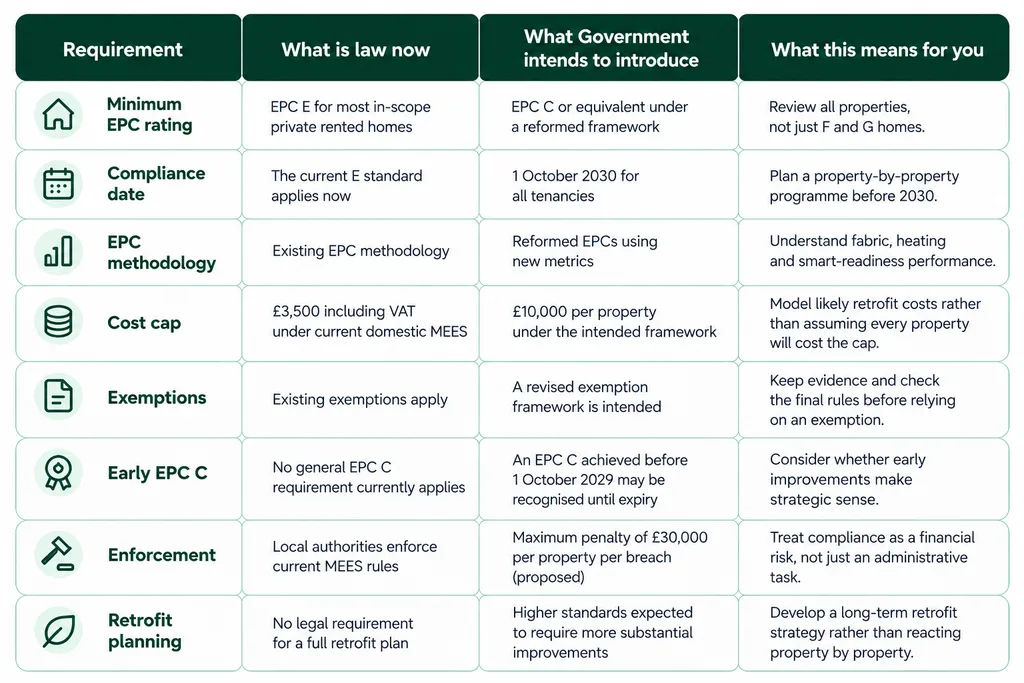
The future cost cap is particularly important. The Government proposes that landlords invest up to £10,000 per property in relevant energy efficiency improvements before a cost-cap exemption may apply, subject to the final regulations. Government impact assessments have estimated average spending of around £5,400 per property, although individual properties can vary considerably in their condition, construction and improvement requirements.
The £10,000 cap is not a prediction of what every property will cost. One property may need relatively modest improvements, while another could require substantial investment. The only sensible way to understand the likely cost is to assess the property and identify the improvements it actually needs. For further details, consult the gov.uk.
The policy is not simply about making EPC certificates look better. The Government's stated objectives include improving the energy performance of privately rented homes, reducing energy bills and helping tackle fuel poverty.
There is also a fundamental tenant issue. Tenants cannot usually choose how well insulated their landlord's property is, replace the heating system or install external wall insulation. Yet they experience the consequences of poor building performance through higher energy consumption, colder rooms and potentially greater difficulty keeping their homes comfortable.
The intended outcome is warmer, more affordable homes. But achieving that outcome requires more than obtaining another EPC certificate. It requires landlords to understand how their properties perform and which improvements are appropriate.
The 2030 deadline may seem distant. For landlords with large property portfolios, however, the challenge is considerable. Each property may have different insulation, heating, construction and investment requirements. You cannot treat every property as the same project. You need to understand your portfolio, identify the highest risks and plan improvements in a sensible order.
Create a property-level record covering current EPC ratings and expiry dates, property types, construction methods, insulation levels, heating systems, existing renewable technologies and recommended improvements. You should also record likely retrofit measures, estimated costs, planning or consent constraints, potential funding and tenant considerations.
This turns a collection of EPC certificates into something much more useful: a prioritised retrofit pipeline. Rather than reacting to individual properties as deadlines approach, landlords can identify which homes require the earliest attention and plan investment accordingly.
An EPC is valuable, but it should not be mistaken for a full retrofit strategy. Two properties with the same EPC rating may require completely different interventions to improve their performance. One may need better loft insulation, while another may have solid walls, an inefficient heating system and limited options for conventional insulation.
The rating tells you something about the outcome, but it does not necessarily identify the best investment sequence for the building. A more detailed retrofit assessment can help landlords understand the property, evaluate appropriate measures and plan improvements in a logical order.
The Government is reforming domestic EPCs through the gov.uk. The new system is expected to introduce four headline metrics: fabric performance, heating system, smart readiness and energy cost.
Fabric performance will help assess how well the building retains heat. The heating system metric will assess the property's heating provision, while smart readiness will consider its ability to use smart technologies to manage energy. The energy cost metric will provide an indication of the costs associated with running the property.
The future private rented sector framework is designed around a primary fabric performance requirement and a secondary requirement based on either heating system or smart readiness. This changes the conversation. Rather than asking only how to improve an existing EPC score, landlords will need to understand which combination of improvements is appropriate for each property under the final rules.
The question is no longer simply how to improve an EPC rating. It is which improvements will deliver the required performance for that particular building.
MEES discussions often focus heavily on landlords' obligations. But tenants are the people who live with the consequences of poor building performance. A more energy-efficient property can potentially mean lower energy demand, improved thermal comfort, a warmer home and reduced exposure to volatile energy costs.
However, an energy efficiency measure is not automatically appropriate simply because it improves an EPC score. The building must be understood, the installation must suit the property, and the tenant must be considered. This is particularly important where insulation, ventilation and heating interventions interact.
The objective should not be to make an EPC certificate look better. It should be to improve the home. For further guidance, visit rentsmart.gov.wales.
The proposed higher MEES framework recognises that not every property will be able to reach the required standard through straightforward improvements. The Government has set out a range of intended exemptions, including provisions relating to costs, completed improvements, property value, solid wall insulation, negative impacts, third-party consent and new landlords.
The eligibility criteria, evidence requirements and duration of exemptions depend on the applicable regulations. Landlords should therefore check the final rules before making decisions based on a particular exemption.
An exemption is not the same as having no responsibility. Landlords may still need to demonstrate why a property cannot meet the standard and retain appropriate evidence. Rather than building a strategy around exemptions that may or may not apply, landlords should first understand the property's condition and realistic improvement options.
The financial implications can extend beyond insulation and heating installation costs. Landlords may also need to account for EPC assessments, contractor costs, periods when works affect occupancy, planning constraints, financing and potential enforcement penalties.
The Government intends to increase the maximum civil penalty under the future private rented sector framework to £30,000 per property per breach. This is part of the intended future framework, not the current maximum penalty.
Consider a landlord with 30 properties requiring improvements at an illustrative average of £5,400 each. That would represent approximately £162,000 of potential investment across the portfolio. This is an illustration, not a forecast for any particular landlord. Actual costs will depend on the properties and the measures required.
The point is that portfolio-level exposure can become substantial very quickly. The earlier that exposure is understood, the more opportunity landlords have to prioritise work, plan budgets and investigate funding.

Understanding the Minimum Energy Efficiency Standards (MEES) is only the first step. For landlords managing one property or an entire portfolio, the next challenge is understanding which homes may need improvements, what work could be appropriate, and how to plan ahead for future requirements.
Cyd Innovation helps landlords assess property energy performance and plan a practical route towards more energy-efficient homes.
Contact Cyd Innovation to discuss your portfolio and explore the assessment and retrofit services that may be suitable for your needs.
Record each property's EPC rating, expiry date, construction type, heating system, insulation and existing energy improvements. Do not focus exclusively on F and G properties. A property rated D today may still require substantial investment to meet the future standard.
Develop a risk ranking based on current performance, likely upgrade requirements, estimated costs and property constraints. This helps identify which homes need the earliest attention and gives you a clearer picture of the investment required across your portfolio.
Do not simply install whichever measure appears first on an EPC recommendation list. Consider how insulation, ventilation, heating and renewable technologies interact. The best solution for one property may not be appropriate for another, so improvements should be based on the building's individual characteristics.
The proposed £10,000 cap should not become the default budget for every property. Obtain realistic estimates based on the actual building and the improvements it requires. This will help you prioritise investment and avoid relying on assumptions that may not reflect the property's condition.
Maintain EPCs, assessments, quotes, invoices, installer information, exemption evidence, funding documents and records of completed work. Good record keeping can help demonstrate what has been done and support future compliance decisions.
A retrofit programme should not only ask what improves the EPC. It should also consider what improves the home. Plan for disruption, access, comfort, energy costs and clear communication with tenants. The objective should be to improve the property's performance while considering the experience of the people living there.
The biggest mistake may not be failing to understand MEES. It may be waiting until compliance becomes an immediate problem before doing anything about it.
If a landlord has ten properties rated EPC D, waiting until 2029 to investigate their likely improvement requirements could leave little time to plan costs and schedule work effectively. Contractors, budgets and property access all need to be considered, particularly where several homes require improvements at once.
The better questions are: what will each property need, how much could it cost, when should the work happen, and how can the investment be phased?
These are retrofit planning questions, not simply EPC questions. An EPC is a useful starting point for understanding a building, but it should form part of a wider strategy for improving energy performance.
At Cyd Innovation, we believe landlords should look beyond the minimum requirement. Compliance is important, but it should not be the whole strategy. A good retrofit programme considers the building, the occupants, the direction of regulation and the investment required to improve performance.
It helps landlords move from asking what they must do to understanding what they should do, in what order, and why. This approach can support better investment decisions before deadlines become urgent. It can also help tenants benefit from homes that are not merely compliant, but genuinely warmer and more energy efficient.
MEES stands for Minimum Energy Efficiency Standards. The regulations establish minimum energy performance requirements for certain privately rented properties in England and Wales.
EPC MEES refers to the relationship between a rental property's Energy Performance Certificate rating and the Minimum Energy Efficiency Standards landlords must meet. The current minimum is EPC E for most in-scope domestic private rented properties, while the future framework is intended to move towards an EPC C-equivalent standard using reformed EPC metrics.
The Government intends the higher standard to apply from 1 October 2030 to all private rented tenancies. The legislation required to implement the new standard remains subject to Parliamentary approval.
No. The current legal minimum for most in-scope domestic private rented properties remains EPC E, unless an exemption applies. EPC C is the intended future standard, not the current minimum legal rating.
The Government proposes that landlords will be required to invest up to £10,000 per property in relevant energy efficiency improvements under the future MEES framework. If the property still cannot meet the required standard, a cost-cap exemption may be available under the final rules.
Not necessarily. The proposed framework would require landlords to meet a fabric performance standard and then a secondary standard based on either heating system or smart readiness. Landlords would not automatically be required to replace every working heating system with a heat pump.

Book a meeting with us to get your FREE Housing 2025 guest pass. Or simply pop by our stand, we will be handing out Welsh Cakes!
Award-winning Social Enterprise delivering seamless, high standard compliance, and managed services taking the strain from social landlords and installers.